
To deliver healthy and safe working lives and contribute to productive enterprises
Selecting Slip Resistant Pedestrian Surfaces
See our systematic approach to Slip Risk Assessment and Prevention
The Law
The 2005 Act
- requires safe access and egress for work
- places a duty on those who design buildings or structures to ensure that they are safe
- obliges those who design, supply and install flooring to ensure it is properly tested, safe and has information about safe use, maintenance and cleaning. That information may also be in the Construction Regulations safety file
Regulations require that
- workplaces are clean
- floors, outdoor workstations, work at height surfaces and working platforms are not slippery
- floors do not have dangerous bumps, holes or slopes
- floors are fixed and stable
Design Factors for Slip Resistant Pedestrian Surfaces
High risk areas
- Level changes - avoid unnecessary level changes. For work stairs and steps consider
- Environmental Controls
- Hazardous Steps
- Handrail(s)
- Wet and contaminated areas - identify foreseeable contaminated areas such as wet rooms, wash-up areas, bathrooms
- Employee who slipped in toilet and fractured his wrist awarded €65,000 (April, 2018) - "...no good reason not to use non-slip tiles in a bathroom ..."
- Vehicles - see our Vehicles Slips, Trips and Falls Information Sheet and Metal and Profiled Surfaces Information
- Walkways - identify walkways
- Entrances - the safest approach may be to ensure the floor areas inside and outside the entrance are slip resistant when wet
- The Mapping tool may help identify other site-specific risk areas
Slip resistance
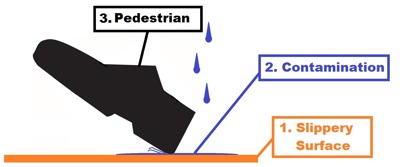
- To determine the slip resistance required from a pedestrian surface, complete a slip risk assessment considering future risks including
- Contamination including spills, cleaning and ice
- Pedestrians including access, footwear and behaviour
- Surface including slip history, slip data and slip-resistance measurements
- Other slip factors, such as sectoral high risk areas, like entrances for most sectors or specific workplace risk factors, like deep fat fryers
- Consider the foreseeable contaminant, for example water, oil, grease
- Consider specification of slip resistance when installed/ in final use conditions, rather than relying on ex-factory results. This should account for any changes due to installation
- Consider specification of a wet Pendulum Test Value (PTV) of 36+ for the surface as installed/ in final use conditions - see Measuring Slip Resistance
- Remember that r-ratings start at 9 (high risk) and go to 13 (low risk) - see Measuring Slip Resistance
- Consider specification of validation testing to confirm the slip resistance of the finished pedestrian surface
- Consider specification that the required slip resistance should last a stated number of years in normal use conditions
- Floor surfaces with directional slip resistance should be fitted to provide slip resistance in the main direction of travel especially on walkways and stairs
- For step edges/ nosings, remember the importance of slip resistance and visual contrast
Cleanability
- HSL UK concluded “the ability to clean a typical hospital floor to a hygienic standard is not influenced by the slip resistance”
- In selecting a slip resistant floor, identify how it should be cleaned and ensure that information is communicated
- The fact that a slip resistant floor requires more than a mop and bucket for cleaning should not prevent it's use
- Consider the need to close sections of floor for wet-cleaning, for example, a fixed retractable cordon system
Durability
- The surface should provide continued slip resistance for its anticipated life, allowing for predicted wear and tear
- This can be tested, for example, using the SATRA Pedatron Test Machine STM 528
Availability of information
- A pedestrian surface must, at least, have information about safe use, maintenance and cleaning
- That information may also be in the Construction Regulations safety file
Heating, Ventilation and Drainage
- Heating, ventilation and drainage should assist removal of surface water, contamination
- Where necessary provide a fall to assist drainage
Shelter
- As required, provide shelter from the elements to reduce slip risk, e.g. entrance canopies, lobbied entrances, covered walkways