safe and
productive lives
and enterprises
Workplace Stress (AKA Work-Related Stress)
Work-related stress (WRS) is stress caused or made worse by work. It simply refers to when a person perceives the work environment in such a way that his/her reaction involves feelings of an inability to cope. It may be caused by perceived/real pressures/deadlines/ threats/anxieties within the working environment (HSA).
At times, when pressures from work are managed well by an individual, it can result in peak performance and be stimulating and motivating. In this instance, an individual may find they are more alert, engaged, and their ability to both work and learn is enhanced.
So, not all challenge is stressful; only some is. Why is that?
There is usually a bell curve involved. We experience challenge so that a certain amount of pressure, over a certain time-frame, is a positive thing. We meet the demands placed on us, perhaps with added training or supports, or on our own. But, after a certain level and a certain period of time, this positive experience diminishes and the pressure, if added to, becomes negative.
If this negative experience is short term, we can often handle it, with supports, training or some extra resources. However, if it continues over an extended time frame, this becomes experienced as stress- a negative fallout from unwelcome pressure. We feel this when we are over challenged and unable to keep up with and master the challenges we face.
(See below for a visual representation of what is known as the Yerkes-Dodson Law).
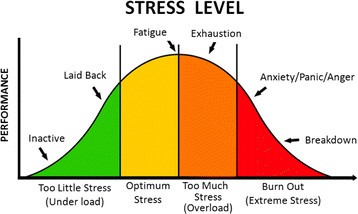
When pressure becomes distress or stress
This tipping point, which can be due to an amount (build-up) of challenge, the timing of the challenge or another issue outside of the challenge area, which is separately reducing our capacity (bereavement/separation/financial worries) can hit us hard.
Other challenges can come from social isolation, sudden change, uncertainty, fear, illness or family conflict. Many of these may have been triggered during Covid, and these can increase our sensitivity to exposure to stress and reduce our resilience generally. When the challenge or pressure point comes from our work – tasks, climate, culture or function….it is called work-related stress. It can also be caused by other factors but made worse by work. Work-related Stress is abbreviated to WRS.
We know that when pressure becomes excessive or unmanageable it can lead to negative effects for the individual and thus for those around him or her. Mental and physical illness can develop if help and supports are not put in place. The main ways to treat stress when it first arises are to seek/offer supports, to have a reliable way to process the distress through talking and problem solving and by reducing or removing the source or cause of the stress.
For more information on Work-related Stress see https://www.hsa.ie/eng/workplace_health/workplace_stress/
Potential causes of Work-Related Stress
- Excessive workloads (workloads in excessive of the role capacity).
- Conflicting demands and lack of role clarity.
- Lack of involvement in making decisions that affect the worker and lack of influence over the way the job is done.
- Poorly managed organisational change, job insecurity.
- Ineffective communication, lack of support from management or colleagues.
- Psychological and sexual harassment, third party violence.
How stress may present itself
Stress can manifest itself in a number of ways.
Physical Effects
- Tiredness, fatigue sense of exhaustion even upon wakening and apathy.
- Indigestion and nausea – general lack of comfort physically after eating.
- Headaches – these can be frequent or rare, mild to severe but are often present in some form throughout the day.
- Aching muscles and joint pains, back-pain, strain.
Mental Health Effects
- Indecisiveness.
- Finding it hard to concentrate.
- Poor memory.
- Feelings of inadequacy.
- Low self-esteem.
- Irritable or angry.
- Anxious.
- Feeling numb/disconnected.
- Hypersensitivity (easily hurt, worried or offended).
- Feeling drained and listless.
Behavioural Responses
- Sleeplessness.
- Change in eating habits (consuming more or less than “normal”).
- Smoking or drinking more.
- Avoiding friends/family/co-workers.
If you are struggling with workplace stress you should speak to your employer and/or to your local GP or medical practitioner.
Further supports are available at:
HSE’s www.YourMentalHealth.ie
Pieta House – www.pieta.ie / Freephone 1800 247 247 every day 24 hours a day / Text HELP to 51444 - standard message rates apply.
Samaritans - www.samaritans.org / Contact jo@samaritans.ie / Freephone 116 123 every day 24 hours a day
Related Files