
To deliver healthy and safe working lives and contribute to productive enterprises
Safe Plan of Action & Risk Assessment Method Statement
Safety Starts with a Plan: Plan It, Brief It, Do It
For Project Supervisors Construction Stage (PSCS), and Contractors
Good planning saves lives. Most serious accidents happen when work is rushed, poorly planned, or not properly supervised. On construction sites, safety starts before work begins – with a clear plan that everyone understands and follows.
This page explains how the Construction Safety Partnership Advisory Committee (CSPAC) standardised Risk Assessment Method Statement (RAMS) and the Safe Plan of Action (SPoA) work together to help you plan, manage and supervise work safely.
What is this page about?
This page brings together two key standardised safety tools approved by the Construction Safety Partnership Advisory Committee (CSPAC) the:
-
Risk Assessment Method Statement (RAMS), and
-
Safe Plan of Action (SPoA)
Used properly, they will help you:
- Plan work safely
- Manage risks before work starts
- Brief workers clearly
- Supervise work on site
Why planning, managing and supervision of work matters
Under safety and health law, work must be adequately:
- Planned – think about the job before you start,
- Managed – provide the right people, time, equipment and training,
- Supervised – check the job is done the safe way every day.
Poor planning and lack of supervision are common causes of serious injuries and deaths on construction sites.
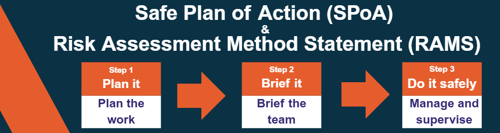
Safety starts with a plan
Before work starts, ask:
- What exactly are we doing?
- How could someone get hurt?
- What controls are needed to keep people safe?
- Who is responsible for managing and supervising the work?
This thinking is captured in your Risk Assessment Method Statement (RAMS) and the Safe Plan of Action (SPoA).
The role of supervision
Good supervision is essential. Supervisors must:
- Be present and contactable,
- Check the site and task each day,
- Ensure workers follow the RAMS and SPoA,
- Deal with changes, new hazards or unsafe behaviour, and
- Stop work if the plan no longer fits the task
Supervision is not paperwork – it is active involvement on site.
The role of the Project Supervisor Construction Stage (PSCS)
Where a PSCS is appointed, they must:
- Coordinate contractors on site,
- Review the RAMS,
- Check that work can proceed safely,
- Ensure cooperation between contractors,
- Be informed of any significant changes,
The PSCS plays a key role in making sure planning turns into safe work on site.
The role of contractors
Good planning does not need to be complicated. For contractors:
- Use plain language,
- Focus on the real risks,
- Be specific about the task and location,
- Use RAMS and the SPoA together,
- Communicate regularly with your workers, and
- Supervise, monitor, and review work practices.
A clear plan and a good briefing protect you, your workers and your business.